Montreal Airport Map: YUL Terminal Layout, Arrivals & Departures Map
Last Updated on Aug 3rd, 2026 by Neha Sharma, Leave a Comment
If you have ever stepped into an unfamiliar airport and felt that first moment of confusion, you know why a clear map matters. Montreal’s airport is easier to figure out than most. It operates from a single terminal building, which removes the stress of shuttling between separate structures. The complexity comes from how that one terminal is divided into different sections for domestic flights, US flights, and international destinations. This guide walks through the Montreal airport map so you know exactly where to go, whether you are arriving, departing, or connecting through YUL.
Montreal Airport Map And Overview
Montréal-Trudeau International Airport, known by its code YUL, sits about 20 kilometres west of downtown Montreal. It ranks as Canada’s third-busiest airport and handles millions of passengers each year. Air Canada uses it as a major hub, and Air Transat is headquartered here. Travellers can fly direct to cities across Canada, the United States, Europe, North Africa, and Asia. One feature worth knowing is the US preclearance facility for border customs, which allows passengers flying to American destinations to clear customs before boarding.
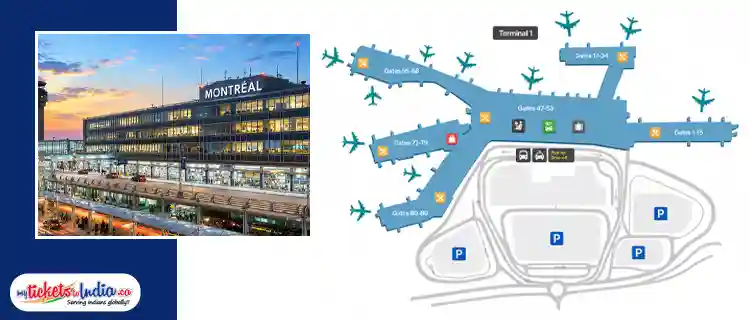
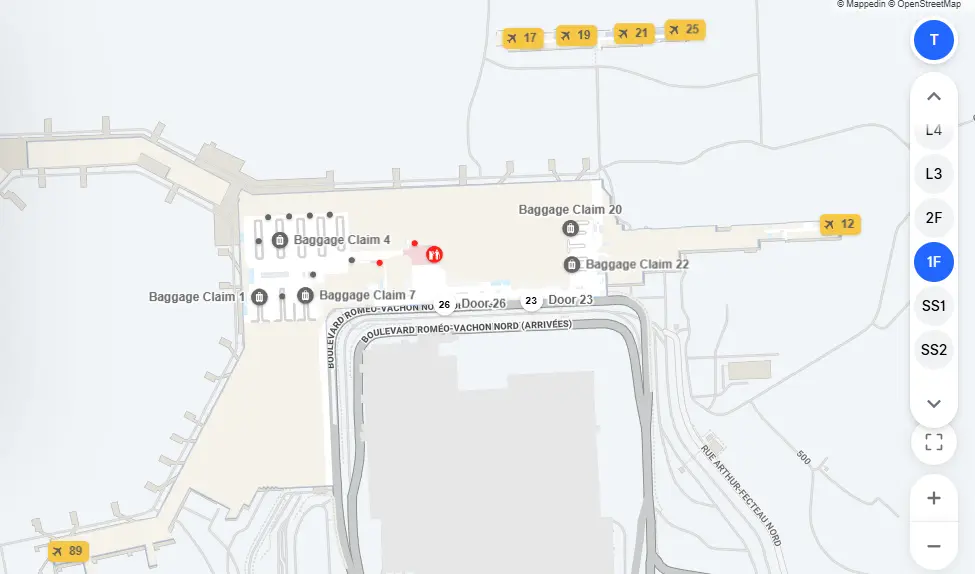
Montreal Airport Terminal Map
The single terminal has two levels. The upper level is for departures. The lower level is for arrivals.
For departures, the public area is divided into two check-in zones. One is for flights within Canada and for international flights. The other is for flights to the United States.
From there, passengers go through security. Checkpoint A serves domestic and international flights. Checkpoint C serves transborder US flights.
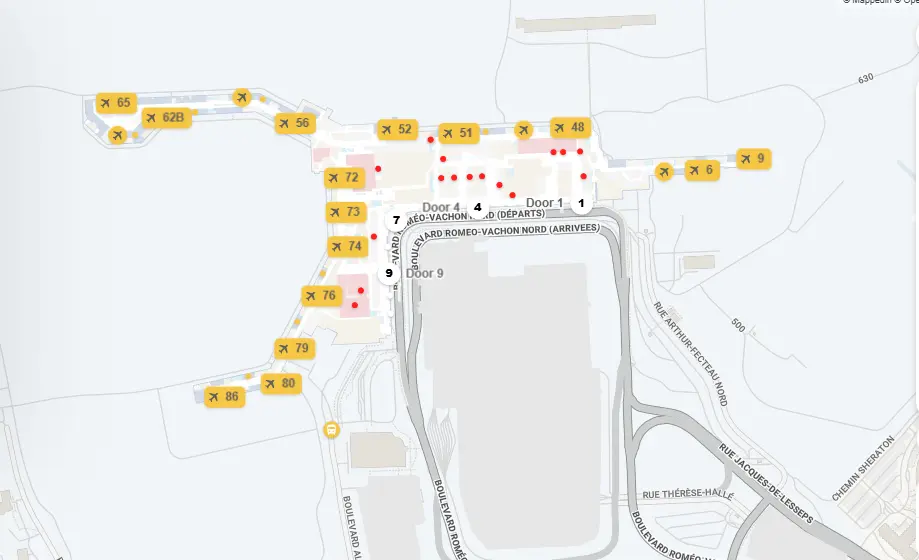
Once past security, passengers enter one of three jetties:
- Domestic Jetty: This zone handles Canadian flights. It is divided into two parts. The main jetty has gates 1-12, 15, and 47-49. The satellite jetty has gates 17, 19, 21, 23, 25, 27, 28, 30, 32, and 34. A tunnel with moving walkways connects the two parts.
- International Jetty: This zone handles overseas flights. It features gates 50-53 and 55-68.
- Transborder Jetty: This zone is for US bound flights only. It has gates 72-89. Passengers here go through US Customs and Border Protection before boarding. Gates 87-89 are one level below and accessible by escalator.
Airlines Operating at Montreal Airport
Most major carriers operate out of YUL. Air Canada and Air Transat account for a large share of the traffic. In addition to these carriers, Porter Airlines and WestJet also operate domestic routes and some to the US. The main US carriers are American Airlines and United Airlines. Air France, British Airways, and Lufthansa connect Montreal to Europe.
| Airline | Primary Operating Section |
| Air Canada | Domestic, International, Transborder |
| Air Transat | Domestic, International |
| Porter Airlines | Domestic |
| WestJet | Domestic, Transborder |
| United Airlines | Transborder |
| American Airlines | Transborder |
| Air France | International |
| British Airways | International |
| Lufthansa | International |
Montreal Airport Transportation Map
Getting around the terminal is generally straightforward. Most walking is done on one level once you are past security. Moving walkways help cover longer distances. Walking from the main security checkpoint to the farthest international gates can take around fifteen minutes. You can reach the satellite domestic gates through a tunnel with moving walkways, which saves time.
Outside the airport, several transportation options connect you to Montreal and surrounding areas. The 747 bus line runs between the airport and downtown, with stops at major hotels and transit stations. Taxis are available just outside the arrivals area. Ride-sharing services like Uber operate from designated pickup zones. Rental car counters are located inside the terminal near the arrivals level. If you are connecting to another flight, the terminal is compact enough that you do not need to take transportation between gates.
Montreal Airport Parking Map
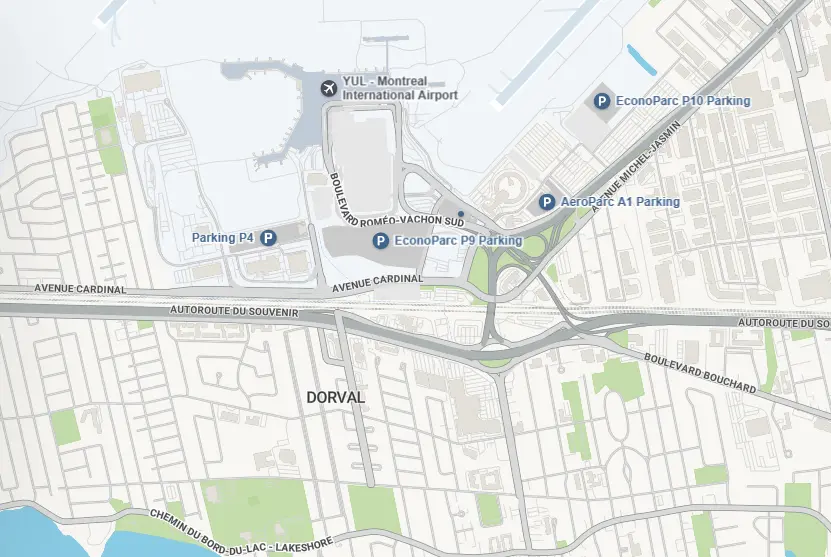
Parking at YUL works for both short visits and extended trips. The main parking structure sits directly across from the terminal. Short-term parking is closest to the doors and works well for picking up or dropping off passengers. Multi-level parking offers covered spots for stays of a few days. Economy parking sits further out and costs less, with a shuttle that runs regularly to the terminal. Valet parking is also available if you prefer to hand off your keys at the curb.
Passenger Facilities at Montreal Airport
WiFi At Montreal Airport: Montréal-Trudeau Airport has a reasonable selection of passenger services. Free Wi-Fi is available throughout the terminal. The connection is usually reliable enough for checking emails and flight updates.
Food At Montreal Airport: Food options range from quick Tim Hortons stops to sit-down restaurants. Several cafes serve coffee and light meals. Duty-free shopping is located in the international and transborder areas, with one of Canada’s largest duty-free stores in the international zone.
Lounges At Montreal Airport: Lounges provide a quieter space for travellers. The Odyssey Lounge near Gate 63, the Plaza Premium Lounge near Gate 76, and the National Bank Lounge near Gate 53 all offer comfortable seating, food, and drinks. Charging stations are scattered throughout the terminal, though finding an available outlet can be a challenge during busy periods. Family rooms and nursing rooms are available for parents travelling with young children. Accessibility services include wheelchairs and assistance for passengers with reduced mobility. Currency exchange counters and ATMs are easy to locate on both levels.
Arrivals and Departures at Montreal Airport Map
The Montreal airport map clearly shows the separation between arrivals and departures.
Departures: The upper level contains all check-in counters and self-service kiosks. After checking in, passengers proceed to their designated security checkpoint. From there, they follow the signs to their gate in the domestic, international, or transborder jetty.
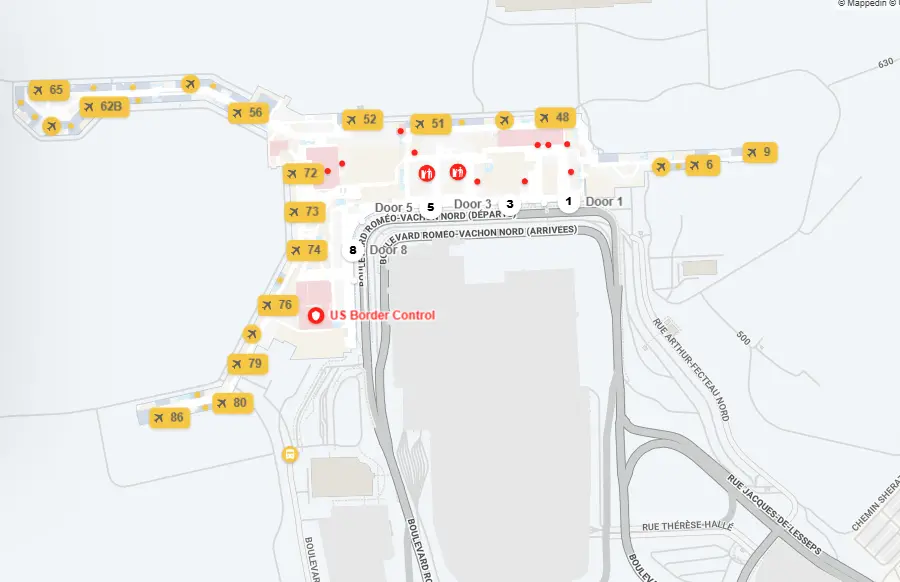
Arrivals: The ground floor is where all arriving passengers end up. Baggage claim carousels are located here. International arriving passengers go through immigration and customs first. Passengers arriving from the US will have already cleared US customs in Montreal. Information desks are located near the baggage claim area to help with onward travel or directions.
Tips for Using the Montreal Airport Map
- A few practical pointers make navigating YUL easier.
- Confirm your departure section before you arrive. Knowing whether you are flying domestically, transborder, or internationally determines where you need to go.
- Give yourself extra time for international flights. Security lines can be long, especially in the early morning.
- Check your gate information regularly. Airlines sometimes change gates without much notice.
- Follow the overhead signs. YUL’s signage is clear and well placed.
- Keep your boarding pass handy. You will show it multiple times from check-in through boarding.
- Allow extra time if you are flying to the US Preclearance adds an extra step, and the lines can move slowly during peak hours.
- Consider using the airport’s digital maps. The YUL website has a downloadable map you can save to your phone.
- Review parking options in advance. Economy parking fills up on busy travel days.
Frequently Booked Flights from Montreal to India
- Montreal to Ahmedabad Flights
- Montreal to Amritsar Flights
- Montreal to Bangalore Flights
- Montreal to Chennai Flights
- Montreal to Delhi Flights
- Montreal to Hyderabad Flights
- Montreal to Kochi Flights
- Montreal to Kolkata Flights
- Montreal to Mumbai Flights
Conclusion
Montréal-Trudeau International Airport runs from a single terminal with four distinct travel sections. Knowing which section serves your destination saves time and reduces uncertainty. The domestic, transborder, and international areas each have their check-in zones and security checkpoints. Once you understand this basic layout, moving through YUL becomes straightforward. Pay attention to signage and allow enough time for security and preclearance, and you will find Montreal’s airport manageable and efficient.
Frequently Asked Questions
Q: How many terminals does Montreal Airport have?
Q: What is the difference between domestic, international, and transborder at YUL?
Q: Which security checkpoint should I use at Montreal Airport?
Q: How long does it take to walk between gates at YUL?
Q: Does Montreal Airport have US preclearance?
All brand names and trademarks mentioned are the property of their respective owners and are used for educational purposes only. We do not promote, endorse, or criticise any brands. Their use is solely for reference and informational context.

About Neha Sharma | View Posts
Neha Sharma, a passionate travel blogger with more than 2 years and 6 months of experience, captures the beauty of the world through her words. With her adventurous spirit and a keen eye for detail, Neha takes her readers on mesmerizing journeys to exotic destinations. Her vivid descriptions and insightful tips make her the go-to guide for wanderlust seekers. Join Neha as she explores the globe, sharing her love for travel and inspiring others to go on their unforgettable adventures.
Latest Blog
-
 Dussehra 2026: Canada Date, Muhurat & Flights To India
11 Sep 2026 -
 Nonstop Mumbai to Toronto Flights Coming for Winter 2026–27
07 Sep 2026 -
 Kerala Is Now Officially Keralam: What Canadian Travellers Need to Know
04 Sep 2026 -
 Sharad Navratri 2026: Dates, Celebrations, Muhurat & Travel Guide from Canada
03 Sep 2026